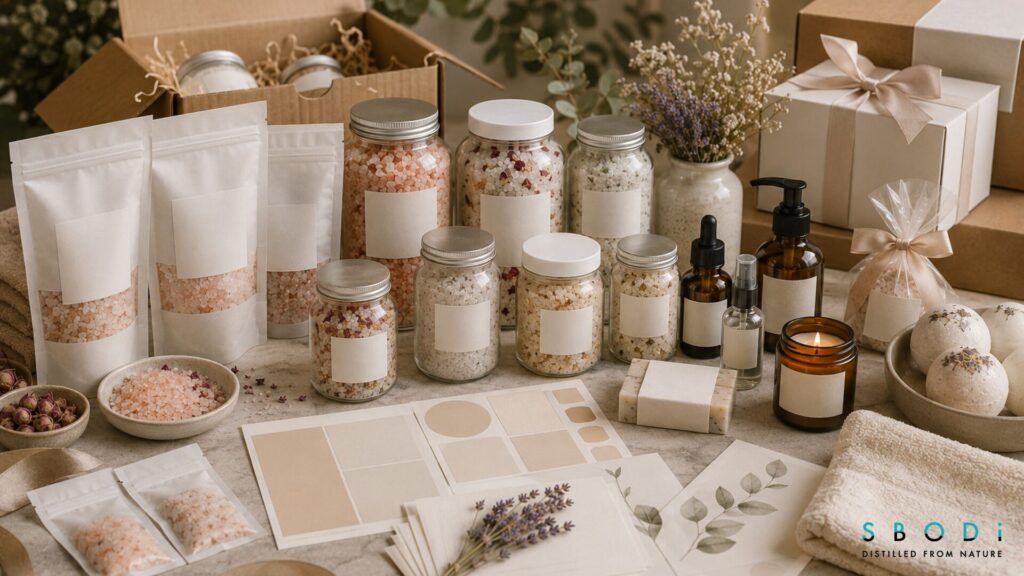
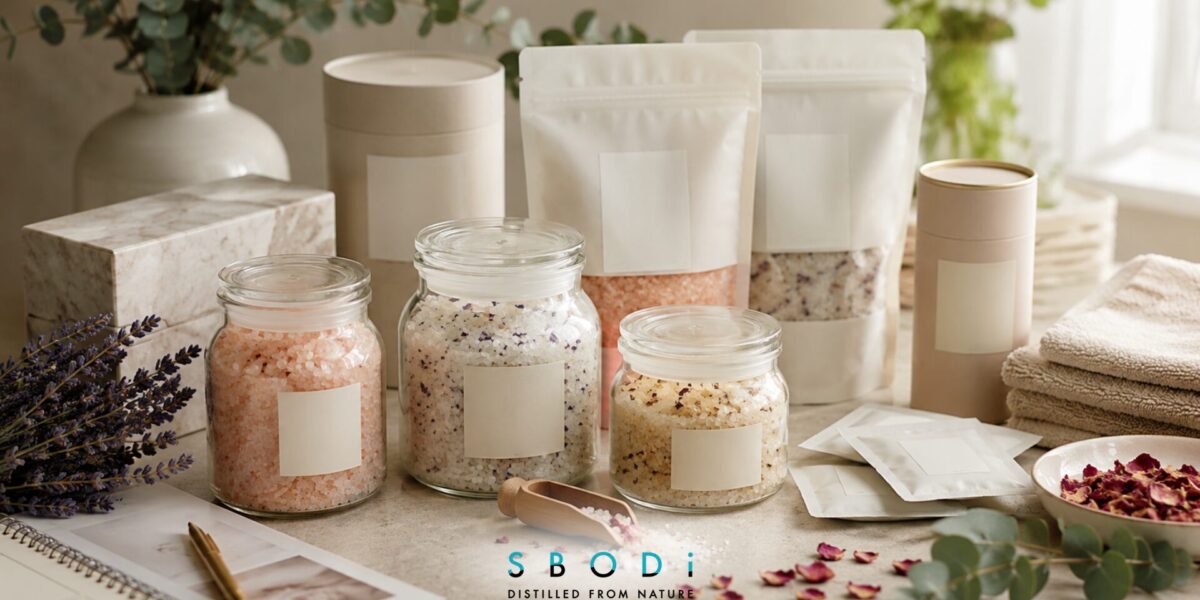
Creating a luxury bath product requires more than placing attractive salts in a decorative jar. A successful private label bath salts brand needs a clearly defined audience, consistent sensory identity, appropriate formulation, protective packaging, accurate labeling, disciplined pricing, and a reliable manufacturing process.
Luxury positioning also needs to feel credible at every customer touchpoint. The scent, salt texture, package weight, label material, product photography, directions, shipping box, and website copy should support the same brand promise.
This guide explains how to develop a distinctive bath salt collection, work with a bath salts manufacturer, evaluate samples, plan packaging, control claims, calculate costs, and connect bath salts with related wholesale bath and body products. It is designed for new founders, wellness brands, boutiques, spas, ecommerce retailers, and established businesses expanding into premium bath products.
Table of Contents
- What Is a Luxury Bath Salts Brand?
- Why Private Label Bath Salts Work for Luxury Brands
- Industry Overview: Where Luxury Bath Salts Fit
- Define the Customer Before Developing the Product
- How to Create a Luxury Private Label Bath Salts Brand
- Choose the Right Bath Salt Product Categories
- Formulation and Ingredient Considerations
- Selecting a Bath Salts Manufacturer or Supplier
- Manufacturing and Quality-Control Considerations
- Packaging Luxury Private Label Bath Salts
- Labeling, Claims, and Regulatory Responsibilities
- Pricing and Landed-Cost Planning
- Building a Complete Luxury Bath and Body Collection
- Marketing and Launching the Brand
- Common Mistakes to Avoid
- Best Practices for Long-Term Brand Development
- Future Trends in Luxury Bath Salts
- Continue Your Bath Salts Research
- How SBODi Supports Bath Product Planning
- Frequently Asked Questions
- Conclusion
What Is a Luxury Bath Salts Brand?

A luxury bath salts brand is a coordinated product concept designed to deliver a refined sensory, visual, and purchasing experience.
Luxury does not automatically mean expensive ingredients, glass packaging, gold foil, or elaborate decorations. Those elements can contribute to premium positioning, but they do not create a luxury brand by themselves.
A credible luxury bath product normally combines:
- A clearly identified target customer
- A consistent visual identity
- A recognizable scent direction
- Carefully selected ingredients
- Controlled product texture and appearance
- Protective, functional packaging
- Clear directions and ingredient information
- Professional photography and product content
- Reliable production quality
- Appropriate retail pricing
The strongest luxury brands make deliberate choices. Their fragrance, naming, package structure, color palette, product size, and supporting content feel like parts of one system rather than unrelated design decisions.
Luxury Is a Customer Perception
A customer does not inspect the manufacturing records before purchasing a bath soak. Instead, the customer evaluates visible and sensory signals.
These signals include package weight, closure quality, label alignment, fragrance character, salt consistency, photography, product descriptions, and the condition in which the order arrives.
Consequently, luxury positioning should be evaluated across the complete customer experience, not only through product appearance.
Why Private Label Bath Salts Work for Luxury Brands
Private label bath salts allow a business to sell a finished bath product under its own brand while relying on another company for some or all of the formulation, production, filling, and packaging work.
Depending on the manufacturer, the buyer may be able to select:
- Salt bases
- Fragrances
- Colors
- Botanicals
- Product sizes
- Containers
- Labels
- Outer packaging
- Collection names
- Custom formula requirements
This model can reduce the need to build an internal manufacturing operation. However, it does not remove the brand owner’s responsibilities for product selection, supplier qualification, labeling, safety, marketing, inventory, and customer experience.
Advantages of Private Label Development
Private labeling can provide several practical advantages:
- Faster entry than developing an internal production facility
- Access to established formulas and manufacturing processes
- More control over branding than ordinary wholesale products
- Opportunities to create coordinated product collections
- Easier expansion into related wholesale bath products
- Potential access to formulation, filling, and packaging expertise
- More consistent production than informal small-batch methods
Private label manufacturing is particularly useful when the founder’s main strengths are branding, ecommerce, retail merchandising, hospitality, spa services, or digital marketing rather than cosmetic production.
Private Label, White Label, and Wholesale Bath Salts
These terms are related but should not be treated as exact synonyms.
Wholesale bath salts are purchased in business quantities for resale or professional use. They may retain the supplier’s branding or arrive in generic bulk packaging.
White label bath salts usually use an existing standard formula that multiple buyers can sell under their own labels.
Private label bath salts may include greater control over labels, packaging, fragrance selection, product names, or formula direction.
Custom bath salts generally involve more extensive development, such as a unique formula, exclusive fragrance, specialized ingredients, custom packaging, or defined performance requirements.
The exact meaning varies between suppliers. Buyers should ask what each program includes instead of relying only on the terminology.
Industry Overview: Where Luxury Bath Salts Fit
Bath salts can support several business models because they are familiar, visually adaptable, and suitable for both individual purchases and gift collections.
They can be positioned for:
- Wellness boutiques
- Spas and salons
- Hotel gift shops
- Subscription boxes
- Ecommerce stores
- Lifestyle brands
- Corporate gifting
- Bridal and event gifting
- Seasonal retail collections
- Private label bath and body ranges
Their loose, multi-use format also differentiates them from pre-portioned bath bombs. Customers can adjust the amount used, while brands can offer multiple package sizes and price points.
Why Bath Salts Support Premium Positioning
Bath salts provide substantial flexibility in presentation. The same basic category can be developed as a minimalist mineral soak, botanical blend, fragrance-led bath product, giftable tube, refill pouch, or coordinated spa collection.
However, premium positioning depends on execution. A high retail price will not compensate for weak fragrance quality, clumping, leaking closures, inconsistent fill levels, unclear directions, or generic packaging.
The current U.S. cosmetic regulatory environment also requires brands to take safety substantiation, facility registration, product listing, adverse-event reporting, and related responsibilities seriously where those provisions apply. Certain small-business exemptions exist, but they should be evaluated carefully rather than assumed.
Define the Customer Before Developing the Product
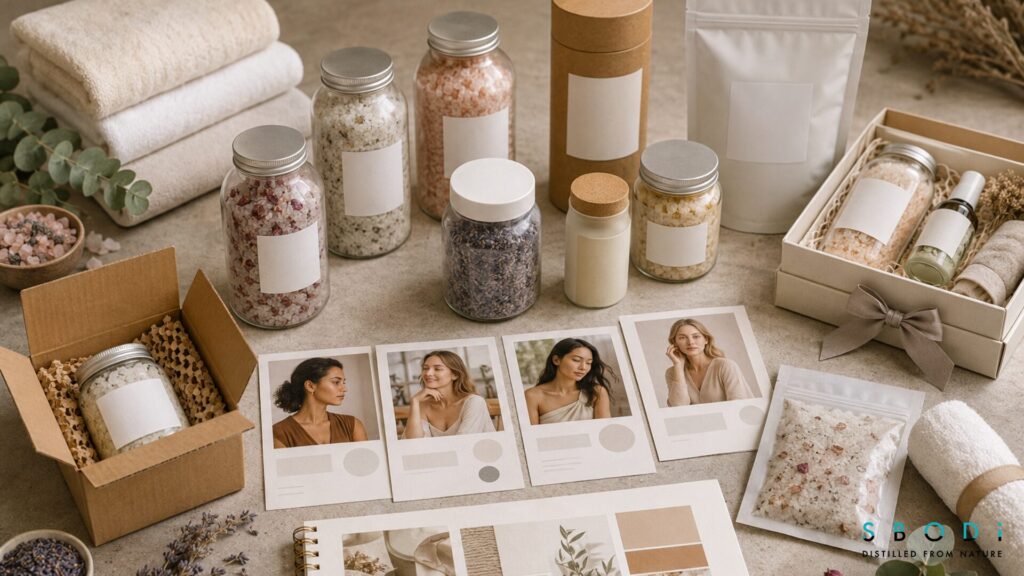
Product development should begin with a specific customer and use environment.
A bath salt designed for a hotel gift shop may require different packaging, sizing, pricing, and fragrance intensity than a product sold through a luxury ecommerce store.
Potential Customer Segments
| Customer Segment | Product Direction | Packaging Priority | Likely Buying Motivation |
|---|---|---|---|
| Boutique shoppers | Distinctive scent and giftable presentation | Shelf appeal | Personal purchase or gifting |
| Spa customers | Professional, restrained, sensory positioning | Practical premium packaging | Extending the spa experience |
| Ecommerce customers | Strong photography and shipping protection | Leak and breakage resistance | Convenience and brand discovery |
| Hotel and hospitality buyers | Compact, consistent, easy-to-merchandise products | Space efficiency | Guest gifting or amenities |
| Subscription-box buyers | Trial sizes and themed products | Lightweight packaging | Discovery and variety |
| Premium gift buyers | Coordinated sets and presentation boxes | Unboxing quality | Occasions and seasonal gifting |
Define One Primary Use Case
A new brand should avoid trying to serve every audience at launch.
Select one primary use case, such as:
- Minimalist mineral bath products for design-conscious consumers
- Giftable floral bath soaks for boutiques
- Premium bath products for spa retail
- Fragrance-led bath salts for home rituals
- Hotel and hospitality bath amenities
- Seasonal bath and body gift collections
This decision helps determine the correct formula, container, label, product name, retail price, and sales channel.
How to Create a Luxury Private Label Bath Salts Brand
The following process connects brand strategy with formulation, manufacturing, packaging, compliance, and retail planning.
Step 1: Define the Brand Position
Write a concise positioning statement before choosing ingredients or packaging.
A useful positioning statement identifies:
- The target customer
- The product category
- The main point of difference
- The intended sales environment
- The desired price level
For example:
A minimalist bath and body brand offering fragrance-led mineral bath soaks in reusable, gift-ready packaging for boutique and ecommerce customers.
This statement is more actionable than simply saying the product will be “luxurious” or “premium.”
Develop a Brand Vocabulary
Choose several words that should guide every product decision.
Possible directions include:
- Minimal
- Botanical
- Coastal
- Modern spa
- Heritage
- Romantic
- Earthy
- Fragrance-led
- Resort-inspired
- Contemporary wellness
Then define words that do not fit the brand. A minimalist spa brand, for example, may avoid novelty shapes, intense colors, glitter, crowded labels, and playful fragrance names.
Step 2: Select and Screen the Brand Name
A strong name should be distinctive, readable, memorable, and suitable for future category expansion.
Avoid choosing a name that limits the business to one scent or product. A company may begin with private label bath salts but later add wholesale bath bombs, shower steamers, soaps, candles, body care, or skincare products.
Before investing in packaging, check:
- Domain availability
- Social-media availability
- Search-engine results
- Business-name records
- Similar bath and body brands
- The USPTO trademark database
- Possible pronunciation or spelling problems
USPTO recommends searching for similar trademarks because a conflict can involve more than two identical names. Similar appearance, sound, meaning, or commercial impression may create problems when related goods or services are involved.
Trademark clearance and registration questions should be reviewed with a qualified attorney when necessary.
Step 3: Build a Focused Product Architecture
A new brand rarely needs ten or fifteen bath salt products at launch.
A more controlled starting collection may include:
- One signature product
- One fresh or herbal fragrance
- One floral fragrance
- One citrus or fruit direction
- One unscented or minimally scented option
- One seasonal product, introduced later
This structure provides variety without spreading inventory across too many stock-keeping units.
Create a Good-Better-Best Structure
Different package sizes can establish a clear price ladder:
- Trial size: Sachet or miniature tube
- Core size: Standard jar or pouch
- Premium size: Large jar, boxed container, or gift set
The formula can remain consistent while the format serves different purchasing occasions.
Step 4: Choose the Salt Base
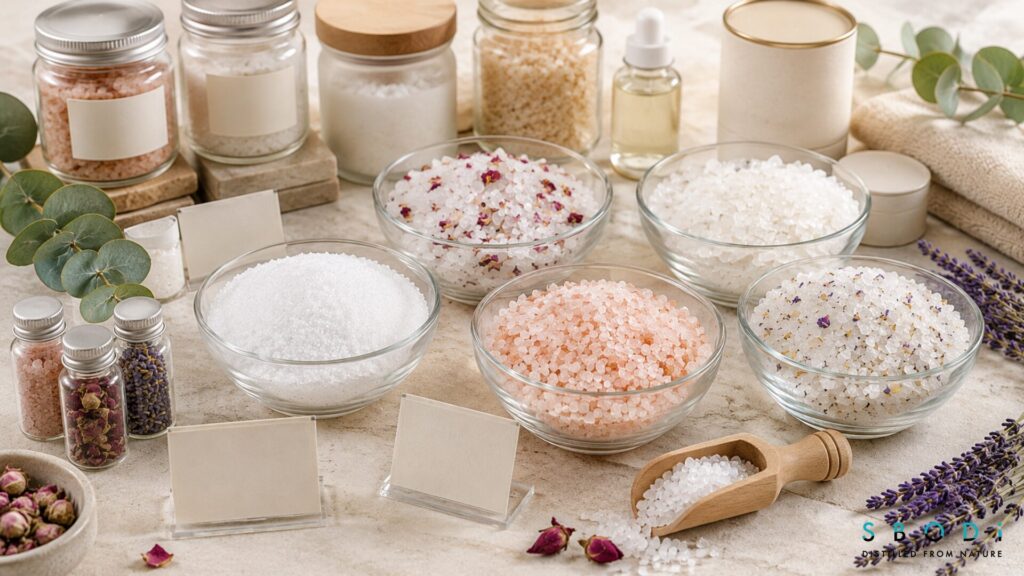
The salt base affects appearance, crystal size, weight, flow, dissolution, cost, and product story.
Common options may include:
- Epsom salt
- Sea salt
- Dead Sea salt
- Himalayan-style mineral salt
- Dendritic salt
- Blended mineral salts
The product name should accurately reflect the formula. A general bath soak may contain salts, powders, oils, fragrance, botanicals, or other ingredients, while a mineral bath salt product may focus more closely on the salt composition.
Ask the manufacturer for the exact ingredient identity, specification, origin information when relevant, and intended cosmetic use.
Evaluate Crystal Size
Crystal size affects both appearance and customer experience.
Large crystals can look decorative but may dissolve more slowly. Fine salts can dissolve faster but may create dust, settle differently, or appear less visually distinctive.
A mixed crystal profile can produce a textured appearance, but the blend must remain consistent during filling and transportation.
Step 5: Develop the Fragrance Direction
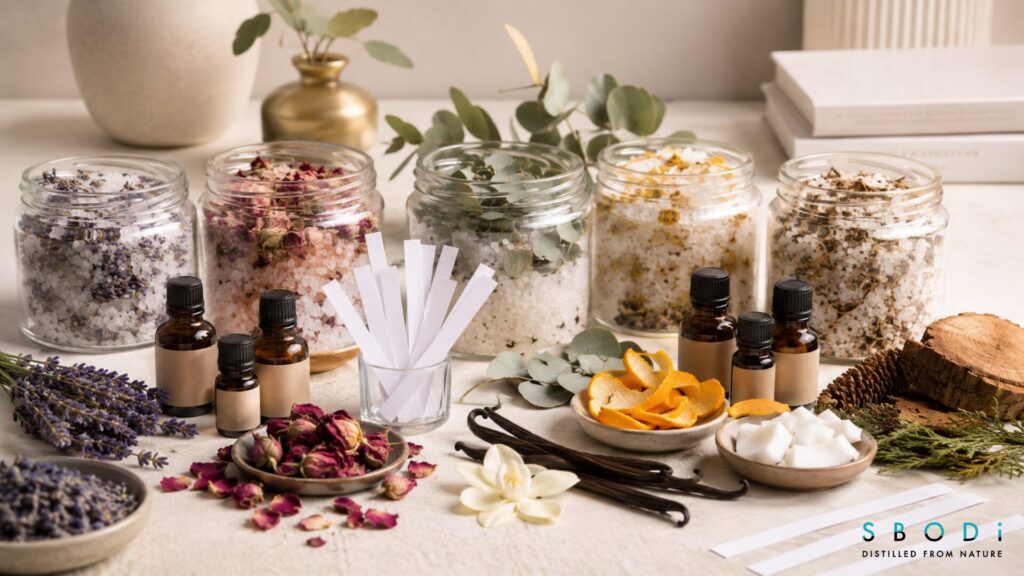
Fragrance often becomes the most memorable part of a scented bath salts collection.
A coherent fragrance strategy may include:
- One recognizable fragrance family
- Several complementary fragrance families
- A location-inspired collection
- A seasonal collection
- A botanical theme
- A fragrance-free or unscented option
Examples of coordinated fragrance directions include:
- Lavender, sage, eucalyptus, and cedar
- Rose, jasmine, neroli, and sandalwood
- Coconut, mango, citrus, and vanilla
- Sea salt, driftwood, mineral, and soft musk
- Amber, fig, cashmere, and warm woods
The fragrance names, packaging colors, website descriptions, and related products should tell the same sensory story.
Use Aromatherapy Language Carefully
“Aromatherapy bath salts” is a common search phrase, but therapeutic claims can change how a product is regulated.
FDA explains that intended use determines whether a product is a cosmetic or drug. Claims that a fragrance product treats disease, affects body function, helps consumers sleep, or provides another therapeutic outcome can create drug implications.
Safer cosmetic positioning focuses on:
- Fragrance character
- Bathing experience
- Product appearance
- Cleansing or beautifying use
- Spa-inspired atmosphere
- Sensory product description
Avoid unsupported promises involving pain, inflammation, anxiety, detoxification, sleep disorders, circulation, muscle recovery, or medical conditions.
Step 6: Decide Whether to Include Color or Botanicals
Color can distinguish product variants, but it also adds formulation and compliance considerations.
Color additives used in cosmetics must be permitted for their intended use. Some also require batch certification. A color approved for one application is not automatically approved for every cosmetic use.
Ask the manufacturer to identify:
- The color additive
- Its cosmetic-use status
- Any applicable restrictions
- Whether certification is required
- The concentration used
- Potential staining or residue concerns
- Batch-to-batch color controls
Botanical Ingredients
Dried flowers, herbs, peels, and leaves can support a premium visual concept, but decorative botanicals are not automatically practical.
Consider:
- Drain residue
- Customer cleanup
- Moisture absorption
- Discoloration
- Fragrance interaction
- Microbial considerations
- Ingredient declaration
- Shipping movement
- Product consistency
A fine botanical powder, extract, or separate reusable bath bag may provide a cleaner customer experience than large loose petals.
Step 7: Select the Right Private Label Model
Ask each prospective bath salts supplier which development level it offers.
Ready-to-Label
The manufacturer supplies a finished standard formula and standard package. The buyer adds its brand label.
This model can support faster launches and lower development complexity.
White Label
An established formula is sold to multiple brands with buyer-specific labels and packaging.
This model provides branding control but limited formula exclusivity.
Made-to-Order Private Label
The buyer selects from approved bases, fragrances, colors, packaging, and other configurable options.
This approach offers greater differentiation without requiring a fully original formulation.
Custom Manufacturing
The manufacturer develops a formula and specification around the buyer’s brief.
Custom projects may require higher minimum order quantities, development fees, more testing, packaging procurement, and longer lead times.
Step 8: Request and Test Samples
Never approve luxury private label bath salts from a fragrance description or digital image alone.
Test the product under realistic conditions.
Evaluate:
- Dry fragrance
- Fragrance during use
- Crystal uniformity
- Dissolution
- Color dispersion
- Residue
- Oiliness
- Botanical behavior
- Package opening
- Scoop usability
- Closure performance
- Label adhesion
- Product condition after transport
- Customer directions
Keep structured notes for every sample. A scoring sheet makes comparisons more reliable than informal impressions.
Step 9: Establish the Packaging System
Luxury packaging should balance appearance with protection, filling efficiency, storage, shipping, customer use, and cost.
The package must also protect the product from humidity. Bath salts can absorb moisture, clump, transfer fragrance, damage paper labels, or become difficult to pour when the package barrier is inadequate.
Packaging should be selected alongside the formula, not after formula approval.
Step 10: Develop Compliant Labels and Product Copy
The brand owner should obtain complete ingredient and labeling information from the manufacturer before approving artwork.
For U.S. retail cosmetics, the principal display panel generally needs the product identity and an accurate net quantity statement. The information panel generally includes the business name and place of business, while retail cosmetics require an ingredient declaration presented according to applicable rules.
Claims on the website, packaging, advertisements, social posts, testimonials, and retailer listings should be reviewed together. A restrained label does not correct an unsupported therapeutic claim on a product page.
Step 11: Calculate Landed Cost and Retail Pricing
The unit manufacturing price is only one component of product cost.
Include:
- Formula cost
- Filling cost
- Primary packaging
- Closure
- Scoop or accessory
- Label printing
- Carton or sleeve
- Setup fees
- Freight
- Duties when applicable
- Warehousing
- Fulfillment
- Ecommerce payment fees
- Damage allowance
- Photography
- Sampling
- Retailer margin
- Promotional discounts
Calculate landed cost before approving expensive packaging.
A package that appears affordable at prototype quantity may require a substantial custom-packaging minimum or create high shipping costs because of weight and dimensional volume.
Step 12: Plan the Launch as a Product System
A luxury launch should present the collection consistently across:
- Product pages
- Category pages
- Email campaigns
- Social media
- Wholesale line sheets
- Retail displays
- Sample packs
- Packaging inserts
- Gift sets
- Photography
- Customer support
The product should not appear botanical on the website, clinical on the package, playful on social media, and generic in the shipping box.
Consistency strengthens recognition and supports premium pricing.
Choose the Right Bath Salt Product Categories
A focused collection can use several bath salt formats without becoming confusing.
Signature Mineral Bath Salts
A signature mineral blend can establish the brand’s core fragrance and visual identity.
This product should be available consistently rather than functioning only as a seasonal item.
Scented Bath Salts
Scented bath salts allow a brand to develop recognizable fragrance families and coordinated gift products.
The fragrance must remain stable in the selected package and consistent between batches.
Unscented Bath Salts
An unscented option can broaden the collection for customers who prefer a simpler formula.
Do not use “hypoallergenic,” “allergy-safe,” or similar language without adequate support.
Botanical Bath Soaks
Botanical-style bath soak products may combine salts with dried materials, powders, oils, or extracts.
The product should be assessed for dispersion, cleanup, residue, package compatibility, and ingredient stability.
Single-Use Sachets
Sachets can support:
- Hotel amenities
- Trial purchases
- Subscription boxes
- Event gifting
- Product discovery
- Travel formats
However, the package must still provide an appropriate moisture and fragrance barrier.
Seasonal Bath Salts
Seasonal products can generate interest without permanently expanding the core range.
Examples include:
- Spring florals
- Summer citrus
- Autumn woods
- Winter spice
- Valentine’s Day gift sets
- Mother’s Day collections
Use existing packaging components where possible to reduce leftover seasonal inventory.
Gift Sets
Bath salts can be paired with:
- Wholesale bath bombs
- Private label bath bombs
- Wholesale shower steamers
- Private label candles
- Wholesale soap bars
- Wax melts
- Body oils
- Lotions
- Bath accessories
The products should share a recognizable fragrance, color, ingredient story, or use occasion.
Formulation and Ingredient Considerations
A luxury formula should be developed around measurable performance, not only an attractive ingredient list.
Request Ingredient Specifica tions
Ask the manufacturer for information such as:
- Ingredient identity
- Supplier specification
- Cosmetic suitability
- Lot traceability
- Storage requirements
- Color or odor limits
- Documentation availability
- Allergen information when relevant
- Country of origin when material
- Certificate of analysis availability
The depth of documentation may vary by ingredient and supplier, but the manufacturer should be able to explain how incoming materials are identified and controlled.
Natural Does Not Automatically Mean Safe
Terms such as “natural,” “botanical,” and “organic-inspired” can influence customer perception, but they do not replace product safety evaluation.
FDA specifically notes that choosing ingredients described as natural or organic does not guarantee safety. Manufacturers and marketers remain responsible for ensuring that cosmetics are safe under labeled or customary conditions of use.
Oils and Fragrance Load
Added oils can affect:
- Salt flow
- Clumping
- Tub residue
- Package staining
- Label adhesion
- Slip characteristics
- Fragrance retention
- Product appearance
The highest possible oil or fragrance level is not necessarily the best luxury formula. Controlled, balanced performance is usually more important than intensity.
Selecting a Bath Salts Manufacturer or Supplier
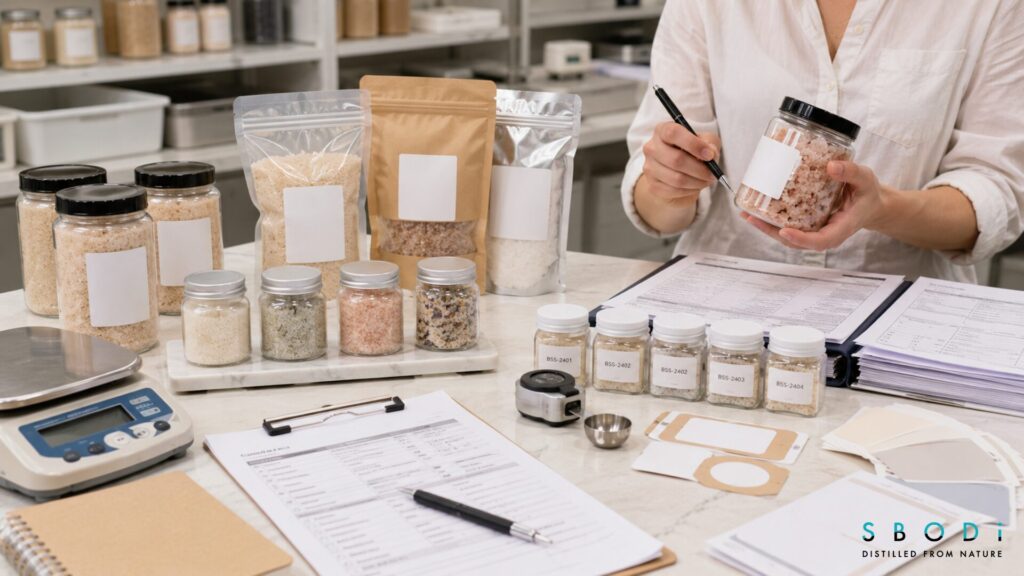
A supplier should be evaluated as an operational partner, not only as a source of attractive samples.
Ask prospective manufacturers about:
- Available formulas
- Customization options
- Minimum order quantities
- Development fees
- Sample costs
- Production lead times
- Packaging procurement
- Label application
- Formula ownership
- Fragrance exclusivity
- Batch records
- Lot coding
- Ingredient documentation
- Finished-product specifications
- Storage conditions
- Complaint handling
- Reorder consistency
- Shipping methods
Questions About Regulatory Responsibilities
Ask which party will act as the responsible person named on the label and how applicable MoCRA duties are handled.
This discussion may include:
- Facility registration
- Cosmetic product listing
- Annual listing updates
- Safety-substantiation records
- Serious adverse-event procedures
- Label contact information
- Record retention
- Complaint escalation
FDA identifies the responsible person as the manufacturer, packer, or distributor whose name appears on the cosmetic label. MoCRA obligations and exemptions should be assessed according to the actual product, facility, and business structure.
Assess Communication Quality
Supplier communication during sampling often predicts the quality of the later relationship.
Warning signs include:
- Vague answers about ingredients
- Unexplained formula substitutions
- Inconsistent quotations
- Missing packaging specifications
- Unclear ownership of artwork or formulas
- Repeated sample differences
- Refusal to discuss quality controls
- No written approval process
- No defined lead-time assumptions
Manufacturing and Quality-Control Considerations
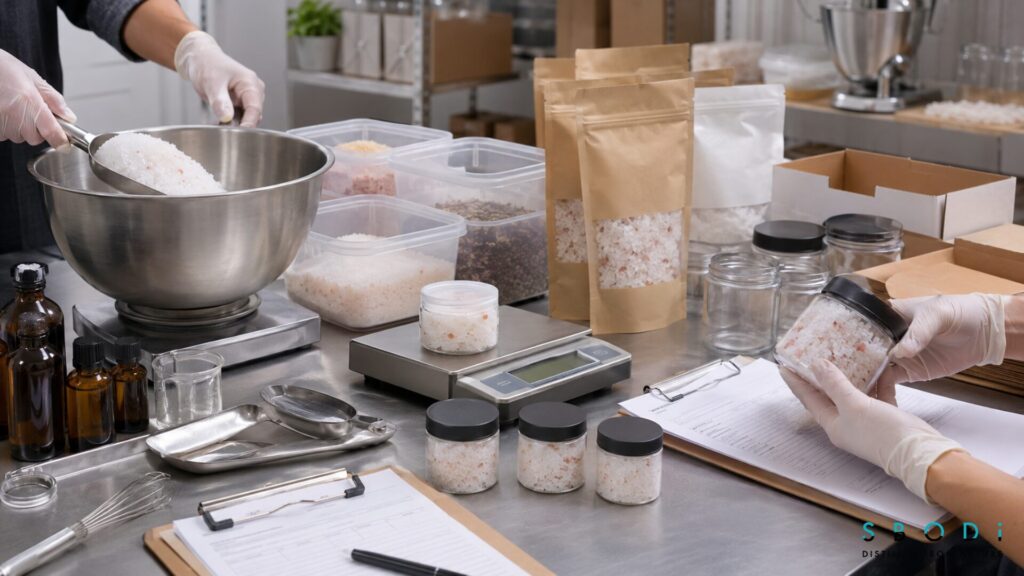
Bath salts appear simple, but consistency still requires documented controls.
Raw-Material Controls
The manufacturer should have a method for receiving, identifying, storing, and releasing raw materials.
Salt, fragrance, oils, colors, botanicals, and packaging should be protected from contamination, moisture, mix-ups, and deterioration.
Batch Documentation
A batch record can document:
- Formula version
- Ingredient lot numbers
- Weighed quantities
- Production date
- Mixing sequence
- Processing observations
- Yield
- Fill count
- Packaging components
- Lot code
- Release approval
This information supports traceability when a complaint, inconsistency, or packaging problem occurs.
Finished-Product Specifications
Specifications may include:
- Appearance
- Color
- Odor
- Crystal distribution
- Fill weight
- Package condition
- Label placement
- Closure application
- Lot coding
- Acceptable clumping limits
FDA does not prescribe one universal test program for every cosmetic. However, the responsible person must maintain records supporting adequate safety substantiation, using scientifically robust information appropriate to the product.
Packaging Compatibility
Run compatibility checks using the intended formula and production package.
Observe samples over time for:
- Fragrance loss
- Oil migration
- Label lifting
- Container distortion
- Closure loosening
- Color change
- Clumping
- Corrosion
- Seal failure
- Moisture entry
A package that works for plain Epsom salt may not perform the same way with added fragrance, oils, powders, or botanicals.
Packaging Luxury Private Label Bath Salts
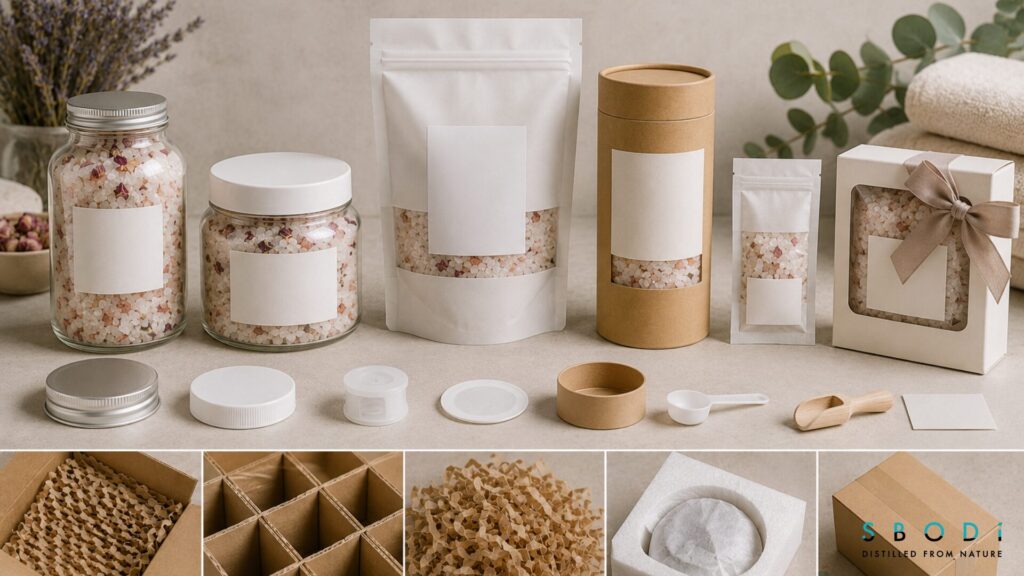
Packaging should make the product easy to identify, protect, open, measure, store, and ship.
| Packaging Format | Advantages | Limitations | Best Use |
|---|---|---|---|
| Glass jar | Premium weight and presentation | Breakage, shipping weight, higher fulfillment risk | Boutique and gift-focused products |
| PET or PP jar | Lightweight and impact resistant | Material choice must fit the brand | Ecommerce and repeat-purchase products |
| Stand-up pouch | Lightweight, efficient, refill-friendly | Can appear less premium without strong design | Refills and larger sizes |
| Paperboard tube with barrier | Distinctive shelf presentation | Requires suitable inner barrier and closure | Gift and boutique collections |
| Single-use sachet | Low trial commitment and compact size | Higher packaging use per application | Samples, hotels, subscriptions |
| Boxed container | Strong gifting and information space | Additional cost and material | Premium sets and seasonal launches |
Moisture Protection
Moisture is one of the most important packaging considerations for bath salts.
Evaluate:
- Container barrier
- Closure fit
- Induction or pressure seal options
- Liner compatibility
- Storage humidity
- Filling-room conditions
- Customer opening and closing
- Ecommerce transit exposure
A decorative package is not luxurious when the product arrives hardened or leaking fragrance.
Sustainable Packaging Claims
A brand may use refill pouches, recycled-content materials, lighter containers, or simplified cartons. However, environmental claims should be specific and supportable.
FTC Green Guides address claims such as recyclable, recycled content, degradable, compostable, and general environmental benefits. Broad claims such as “eco-friendly” may mislead customers when they are not properly qualified.
Use precise wording, such as:
- “Jar made with 30% post-consumer recycled plastic”
- “Paper carton is recyclable where appropriate facilities exist”
- “Refill pouch uses less packaging material than our standard jar”
Verify every statement with packaging documentation and applicable local recycling conditions.
Labeling, Claims, and Regulatory Responsibilities
Luxury presentation does not reduce labeling obligations.
Core U.S. Cosmetic Label Elements
Depending on the package structure and product, a cosmetic label generally needs:
- Product identity
- Accurate net quantity of contents
- Ingredient declaration
- Name and place of business
- Appropriate “Manufactured for” or “Distributed by” language
- Required warnings or directions
- Country of origin for imported products
- Legible and conspicuous presentation
Retail cosmetic ingredients are generally declared in descending order of predominance, with specific provisions for ingredients at one percent or less and color additives.
Obtain a regulatory review before printing a large label quantity.
Do Not Use “FDA Approved”
Cosmetic products and cosmetic ingredients generally do not receive FDA premarket approval, with the notable exception of color additives, which must be approved for their intended uses.
Therefore, ordinary bath salts should not be marketed as “FDA approved.”
Avoid Drug Claims
Bath salts marketed for cleansing, beautifying, fragrance, or appearance may fall within the cosmetic framework.
Claims to diagnose, cure, mitigate, treat, or prevent disease, or affect the structure or function of the body, can create drug classification issues.
High-risk examples include:
- Treats arthritis
- Relieves chronic pain
- Reduces inflammation
- Improves circulation
- Detoxifies the body
- Treats insomnia
- Heals eczema
- Prevents infection
- Relieves anxiety
- Accelerates muscle recovery
The FTC also requires express and implied health-related advertising claims to be truthful, non-misleading, and supported by an appropriate level of reliable evidence.
Review the Complete Marketing Context
Claims may be communicated through:
- Product names
- Label copy
- Images
- Testimonials
- Influencer statements
- Product categories
- Blog articles
- Metadata
- Frequently asked questions
- Social-media captions
- Retailer descriptions
A disclaimer may not correct an otherwise deceptive overall message.
Pricing and Landed-Cost Planning
A luxury bath salts brand needs enough margin to support both product quality and customer acquisition.
Build a Complete Cost Model
Calculate:
Landed cost per unit = product + packaging + labels + freight + duties + receiving + damage allowance + preparation costs
Then include channel-specific expenses:
- Payment processing
- Pick and pack
- Shipping subsidy
- Marketplace fees
- Wholesale discount
- Distributor margin
- Advertising
- Returns
- Samples
- Promotions
Plan for Wholesale and Direct-to-Consumer Channels
A product priced only for direct ecommerce may not support future wholesale expansion.
Before approving the retail price, model:
- Direct-to-consumer margin
- Standard wholesale margin
- Promotional margin
- Gift-set margin
- Subscription-box pricing
- Free-shipping thresholds
- Damaged-product replacement
The luxury appearance should be supported by financially sustainable operations.
Building a Complete Luxury Bath and Body Collection

Private label bath salts can serve as the central product in a broader sensory collection.
Bath Salts and Bath Bombs
Bath salts provide an adjustable, multi-use format. Bath bombs provide a pre-portioned, visually distinctive bathing format.
A brand may coordinate mineral bath salts with:
- White private label bath bombs
- Floral bath bombs
- Fruit-inspired bath bombs
- Individually wrapped bath bombs
- Seasonal custom bath bombs
- Wholesale bath bombs for resale
The fragrance and packaging system should connect the products without making every item visually identical.
Bath Salts and Shower Steamers
Shower steamers extend the collection to customers who do not regularly use a bathtub.
Private label shower steamers can be coordinated through:
- Shared fragrance families
- Matching package colors
- Similar product names
- Trial bundles
- Bath and shower gift boxes
Directions must clearly distinguish shower steamers from bathtub products.
Bath Salts and Candles
Private label candles can extend the fragrance story beyond the bath.
A luxury collection may combine bath salts with:
- Amber jar candles
- White glass candles
- Scented candles
- Wax melts
- Fragrance sample candles
Fragrance matching should be tested rather than assumed. The same fragrance can perform differently in salts, wax, soap, and water-activated products.
Bath Salts and Soap
Wholesale soap bars can add a cleansing format and increase gift-set value.
Suitable options may include:
- Handmade soap bars
- Natural bar soap
- Unscented soap
- Botanical soap
- Coordinated private label soap
- Minimalist branded soap products
The entire set should share a clear audience and price position.
Marketing and Launching the Brand
Luxury branding needs product evidence, not only descriptive language.
Build Strong Product Pages
Each product page should explain:
- What the product is
- Who it is designed for
- Fragrance profile
- Product size
- How to use it
- Full ingredients
- Packaging format
- Care and storage
- Appropriate warnings
- Shipping considerations
- Related products
Avoid filling the page with generic statements such as “premium quality,” “best luxury bath salts,” or “ultimate relaxation.”
Show the evidence through specific formulation, fragrance, packaging, and use information.
Use Professional Product Photography
Create a consistent image set with:
- Clean pack shots
- Texture close-ups
- Packaging details
- Scale references
- Open-container images
- Lifestyle bath scenes
- Gift-set arrangements
- Related product collections
The customer should understand the product size, texture, package opening, and overall presentation before ordering.
Launch With a Controlled Product Range
A focused launch makes it easier to:
- Manage inventory
- Compare scent performance
- collect reviews
- identify repeat purchases
- monitor complaints
- improve packaging
- concentrate marketing expenditure
- maintain visual consistency
Additional scents and sizes should be introduced after the initial products produce useful customer and operational data.
Common Mistakes to Avoid
Treating Luxury as Decoration
Foil labels, glass containers, and dried petals do not correct weak product performance.
Start with formula consistency, packaging protection, directions, and customer suitability.
Selecting Packaging Before the Formula
Fragrance, oils, particle size, and botanicals can affect the package.
Approve the complete formula-package system together.
Launching Too Many Scents
A large initial range divides inventory and marketing attention.
Start with a controlled fragrance architecture and expand based on evidence.
Ignoring Landed Cost
Low manufacturing cost can be offset by heavy containers, fragile packaging, custom carton minimums, storage, and fulfillment expenses.
Calculate full cost before committing.
Making Unsupported Wellness Claims
Avoid copying claims from competitors. Another company’s wording is not evidence that a claim is compliant.
Review intended use, implied messages, testimonials, imagery, and advertising together.
Assuming Natural Ingredients Are Automatically Better
Natural ingredients can still create stability, safety, fragrance, color, residue, and allergen considerations.
Evaluate every ingredient according to its function and intended use.
Skipping Transit Testing
A product that looks correct in the production facility may leak, clump, break, or lose label adhesion during shipping.
Test realistic parcel conditions before launch.
Using Generic Brand Language
Terms such as luxurious, premium, natural, clean, and high-quality provide little differentiation without supporting detail.
Explain exactly what makes the product distinct.
Best Practices for Long-Term Brand Development
Use these principles to create a more durable private label bath salts business:
- Maintain a written brand-positioning document.
- Keep approved product and packaging specifications.
- Retain samples from production batches.
- Track complaints by product and lot.
- Review claims whenever website copy changes.
- Maintain consistent product photography.
- Use defined fragrance families.
- Introduce new products in controlled stages.
- Calculate margins by sales channel.
- Review supplier performance after every order.
- Maintain current ingredient and packaging documents.
- Build internal links between related educational articles.
- Update regulatory information when guidance changes.
- Use customer feedback to improve directions and packaging.
- Protect the core brand identity while expanding the collection.
Future Trends in Luxury Bath Salts
The following directions are likely to influence premium bath salt product development.
More Restrained Visual Design
Minimal typography, neutral containers, controlled color palettes, and simplified product naming are likely to remain relevant for premium wellness positioning.
The goal is not to remove personality. It is to use fewer visual elements more deliberately.
Refill and Reuse Systems
Brands may combine a durable core container with lighter refill packaging.
This approach requires practical refill instructions, package compatibility, moisture control, and precise environmental claims.
Smaller Discovery Formats
Miniatures and single-use formats can lower the cost of trying an unfamiliar fragrance.
They also support subscription boxes, hotel programs, event gifts, and fragrance discovery sets.
Cross-Category Fragrance Collections
Bath salts will increasingly be developed alongside bath bombs, shower steamers, candles, wax melts, soap, and body care.
The collection will be organized around a fragrance story rather than one isolated product type.
Greater Documentation Expectations
Retailers and brand owners are likely to ask more detailed questions about ingredient specifications, batch traceability, safety substantiation, product listing, facility registration, packaging materials, and complaint processes.
MoCRA has already expanded several federal requirements and authorities affecting U.S. cosmetics, while FDA is continuing work on cosmetic GMP and fragrance-allergen regulations.
Clearer and More Specific Claims
Customers may still respond to natural, sustainable, wellness, and premium positioning, but broad language creates credibility and compliance risks.
Brands that provide specific, verifiable information will be better positioned than those relying on vague marketing terms.
Continue Your Bath Salts Research
Creating a luxury brand becomes easier when the founder understands the wider wholesale and private label bath product category. This broader knowledge helps businesses compare sourcing models, establish realistic order requirements, evaluate packaging, and determine which level of product customization fits their brand strategy.
SBODi’s wholesale bath salts guide for wellness brands explains how wholesale bath salts are sourced, packaged, evaluated, and incorporated into a broader wellness product collection. It also covers product formats, supplier selection, minimum order quantities, packaging options, and the differences between bulk, wholesale, and private label purchasing.
The guide is particularly useful before selecting a private label program because it clarifies the differences between finished wholesale inventory, bulk bath salts, branded products, and custom manufacturing. Businesses planning a wider product range can also review SBODi’s private label bath and body products guide to understand how bath salts can be coordinated with bath bombs, shower steamers, candles, soaps, and related body care products.
Readers specifically researching domestic sourcing can continue with the Private Label Bath Salts USA for Wellness Brands guide. This supporting resource examines product formats, supplier considerations, packaging decisions, customization opportunities, and collection planning for brands evaluating U.S.-based options.
Product planning should also include an understanding of regulatory responsibilities. The FDA’s Modernization of Cosmetics Regulation Act overview explains current federal requirements concerning cosmetic safety substantiation, serious adverse-event reporting, facility registration, and product listing, including exemptions that may apply to certain small businesses.
Before finalizing packaging artwork, businesses should also review the FDA’s cosmetic labeling resources for guidance on ingredient naming and declaration requirements. These external resources do not replace professional regulatory advice, but they provide an authoritative foundation for discussing documentation, labeling, and compliance responsibilities with a bath salts manufacturer.
How SBODi Supports Bath Product Planning
SBODi operates within the wholesale and private label bath and body product category, including bath salts, bath bombs, shower steamers, candles, soaps, and related wellness products. Its website provides product information and educational resources for businesses comparing wholesale inventory, private label branding, product sampling, packaging, and collection development.
The practical value for a developing brand is category coordination.
Instead of evaluating private label bath salts as an isolated product, buyers can consider how fragrance, packaging, quantities, and branding could connect with wholesale bath bombs, shower products, candles, and soaps.
Businesses should still evaluate product samples, written specifications, applicable documentation, pricing, lead times, and responsibilities according to their own requirements before placing an order.
Frequently Asked Questions